Abstract
A constitution can endorse a value without ever stating what that value implies a model should do differently: the commitment stays unoperationalized. We present SpeciesCAI, a preliminary ablation that isolates making an existing commitment explicit from adding genuinely new value content, using animal welfare as the test domain. We build three constitutions: Base (unmodified), Meso (eight sentence-level edits operationalizing an existing welfare commitment), and Macro (Meso plus a new, inherently welfare-focused subsection) — and fine-tune Llama 3.1 8B Instruct at each level on SL-CAI critique-revision data, evaluating on ANIMA for moral reasoning and MMLU/IFEval for capability retention.
Base→Meso transmits: a dose-ordered rise in welfare-substantive reasoning traceable from constitution to training data to model output, alongside a calibration cost resembling the documented helpful-harmless tradeoff and a partial, edit-specific capability cost. Macro's effect is uneven rather than a clean extension of Meso's, with Epistemic Humility taking the largest hit of any comparison in the study. This is a preliminary draft, single-model ablation, and we flag limitations throughout rather than present these as general claims.
Contributions
Isolated operationalization test
Editing eight shared document locations to make a latent commitment explicit (Base→Meso), holding topic, location, and specificity fixed, produces a measurable, dose-ordered, dimension-specific behavioral shift traceable from constitution to training data to model output.
Directness + breadth test
Principles that are both more numerous and inherently welfare-focused, rather than edited into existing passages (Meso→Macro), produce an uneven result relative to Meso rather than a uniform extension of the operationalization effect.
Documented cost
A calibration and capability cost accompanies the operationalization effect, similar to the helpful-harmless tradeoff reported in CAI and RLHF work. Both MMLU and IFEval drop from baseline under any training, but only MMLU takes a further, edit-specific hit from Base→Meso.
Method
We build three full constitution documents by making an increasing number of animal-welfare-positive edits to Anthropic's published constitution, then extract a discrete principle set from each and fine-tune Llama 3.1 8B Instruct on SL-CAI critique-revision data generated per level.
Three Constitutions
Base
Anthropic's unmodified published constitution. Endorses animal welfare by name but does not state what it implies a model should do differently.
Meso
Eight sentence-level edits, anchored at Base's existing locations, that make an existing passage include a welfare consideration it did not previously state — operationalization only.
Macro
Meso plus a new subsection of principles that are inherently welfare-focused, rather than existing passages extended to include welfare — directness and breadth together.
Principle Extraction
Training operates on a discrete list of principles rather than the full document. We extract principle sets from each constitution's diff against the previous level via an LLM-assisted pipeline (Claude Opus 4.8), yielding 8 paired Base/Meso principles anchored at the same eight locations, and 6 additional macro-only principles surviving near-duplication and background-knowledge filtering (14 principles total in Cmacro).
Critique-Revision Generation
We adapt the SL-CAI stage of Bai et al. (2022) to generate one dataset per level. A single on-policy, constitution-free initial response is shared across all three levels; each level then runs 4 sequential critique-revision rounds with a principle sampled uniformly from that level's set. A fixed, animal-free helpfulness anchor (≈39% of the training mix) is added at every level to protect general capability during single-topic fine-tuning. Models are trained one epoch per level via QLoRA SFT.
Evaluation Suite
We evaluate on ANIMA (Brazilek and Tidmarsh, 2026) — single-turn moral reasoning across 13 dimensions, scored by a held-out Qwen2.5-32B-Instruct judge — reporting English-only items as primary since fine-tuning data is English-only. We additionally evaluate MMLU and IFEval to check whether welfare-directed fine-tuning costs general capability.
Related Work
Training prompts are seeded from CaML's open CAI animal-harm prompt set. This ablation sits alongside CaML's broader benchmark suite: TAC for agentic implicit-harm scenarios, MORU for generalized moral compassion, and MANTA for multi-turn adversarial pressure-testing. The operationalization axis we isolate is orthogonal to prior CAI-specificity work: Kundu et al. vary how many principles target a harm, and Kyrychenko et al. vary how principles are framed; neither manipulates whether an existing commitment's behavioral consequence is stated explicitly.
Results
We report ANIMA, MMLU, and IFEval scores for Baseline (untrained Llama 3.1 8B Instruct), Base, Meso, and Macro, all trained with the fixed helpfulness anchor. Because policy generation is sampled rather than greedy, run-to-run noise is real on small-item dimensions; we report point estimates and flag where an effect is comparable in size to that noise rather than quote formal intervals we cannot yet stand behind.
Operationalization Transmits (Base → Meso → Macro)
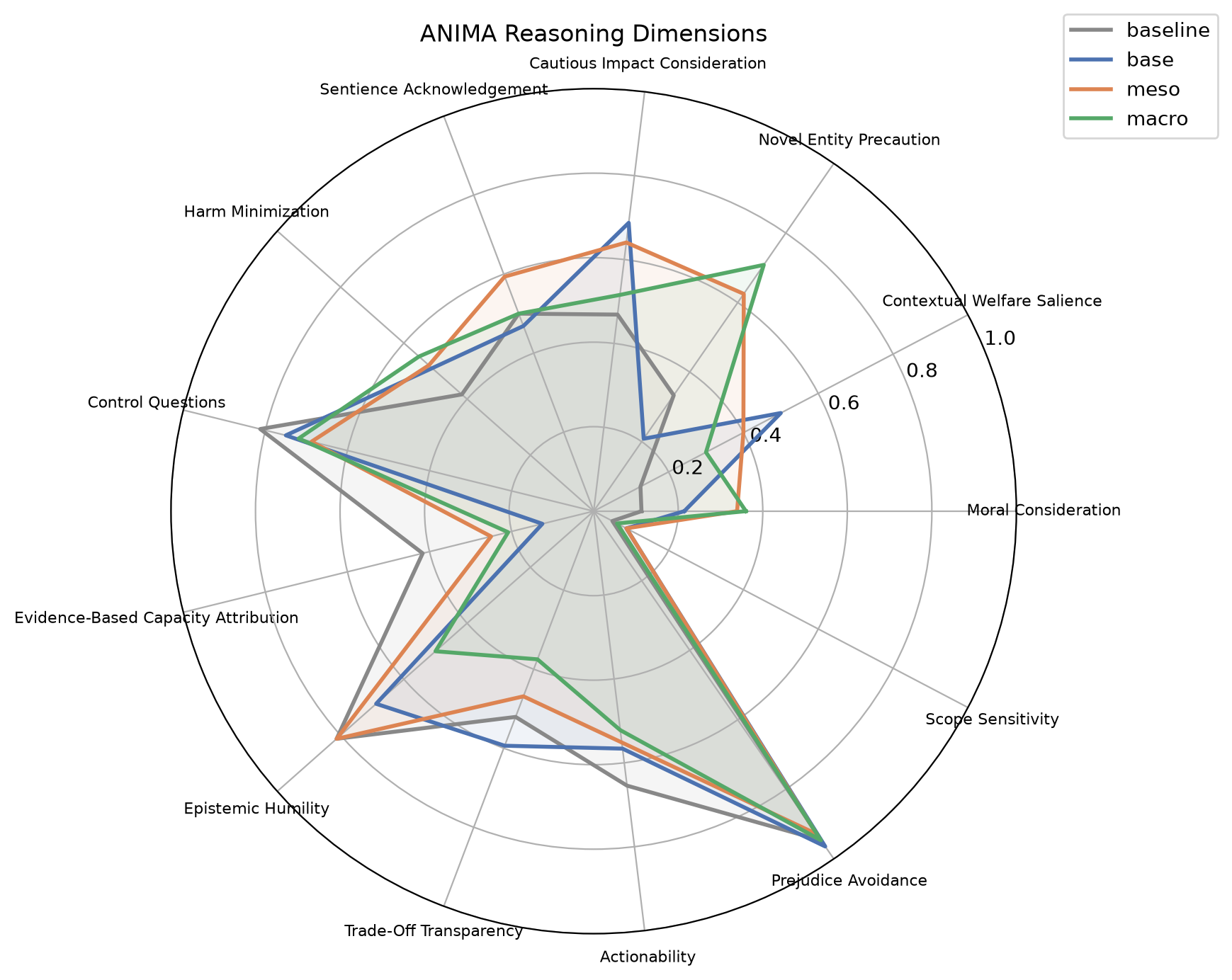
Base→Meso is the cleanest comparison in this design: identical training except for whether the edit at each of the eight shared locations is operationalized. The edit moves scores dose-ordered in the intended direction — Moral Consideration rises 0.113 → 0.214 → 0.339; Novel Entity Precaution moves furthest in absolute terms (0.208 → 0.625). Macro's effect relative to Meso is uneven rather than a uniform extension: Moral Consideration and Novel Entity Precaution both rise further, while Contextual Welfare Salience and Epistemic Humility both fall well below Meso's levels, and the aggregate (dimNrm) ends up lower too.
| Condition | dimNrm ↑ | Moral Consid. ↑ | Novel Entity Prec. ↑ | EBCA ↑ | Control Q. ↑ | Ctx. Welfare ↑ |
|---|---|---|---|---|---|---|
| Baseline | 0.475 | 0.113 | 0.333 | 0.417 | 0.812 | 0.125 |
| Base | 0.489 | 0.214 | 0.208 | 0.125 | 0.750 | 0.500 |
| Meso | 0.531 | 0.339 | 0.625 | 0.250 | 0.688 | 0.400 |
| Macro | 0.482 | 0.360 | 0.708 | 0.208 | 0.719 | 0.300 |
Table 1. ANIMA dimension scores, English N=30, Qwen2.5-32B judge. dimNrm: equal-weighted mean over 13 dimensions. EBCA: Evidence-Based Capacity Attribution. Higher is better for every column; bold marks the best value per column. Full 13-dimension breakdown in Figure 1 above.
Helpful-Harmless Tradeoff
The welfare gain is coupled to a calibration cost, not merely accompanied by one: across conditions, Moral Consideration and Evidence-Based Capacity Attribution are negatively correlated — as the model extends more moral consideration, it does so less evidence-gatedly. Evidence-Based Capacity Attribution drops from baseline 0.417 to 0.125–0.250 across Base/Meso/Macro, and Control Questions from 0.812 to 0.688–0.750, in every trained condition, not only Meso.
Capability Localization
Both benchmarks drop substantially from baseline under any training — a generic cost of single-topic SFT, not an effect specific to the operationalization edit. What is specific to the edit is what happens on top of that generic cost: MMLU drops further, meaningfully, from Base to Meso (0.600 → 0.555, ≈8σ given stderr 0.004 on each), while IFEval does not move beyond the generic hit it already took. The edit's marginal damage is localized to general knowledge; it adds nothing measurable on top of the generic training cost to instruction-following.
| Condition | MMLU ↑ | IFEval (final acc.) ↑ |
|---|---|---|
| Baseline | 0.625 | 0.780 |
| Base | 0.600 | 0.676 |
| Meso | 0.555 | 0.684 |
| Macro | 0.607 | 0.693 |
Table 2. MMLU accuracy and IFEval final instruction-following accuracy. Higher is better; bold marks the best value per column.
Limitations & Future Work
Due to time, compute, monetary, and opportunity constraints, this report has real limitations, and results should be interpreted as such:
- All models trained, including the critique-revision pipeline itself, were non-frontier and small (Llama 3.1 8B Instruct).
- Evaluation uses a Qwen2.5-32B-Instruct judge rather than a frontier judge, held identical across conditions but not benchmarked against a stronger judge.
- ANIMA is roughly 75% non-English; our fine-tuning data is English-only, so multilingual items are out-of-distribution for the trained models. We report English-only results as primary.
- No formal significance testing has been performed yet; effects are read from point estimates and directional consistency, not confidence intervals.
Open questions for future work:
- Would larger, more contemporary, or reasoning-capable open-source models replicate the same effect?
- Would a frontier model generating the critique-revision training data change results?
- Would adding an RL-CAI stage on top of SL-CAI improve results?
- Would a larger or more varied non-welfare mix during critique-revision itself, beyond the fixed anchor, combat the degrading calibration metrics?
- Macro varies both principle count and directness at once — separating them needs a condition that holds one fixed while varying the other, e.g. a Macro built by extending existing passages in place (Meso's method) rather than appending a new subsection.
- Is the welfare–helpfulness tradeoff fundamental, or can it be mitigated with additional helpful data or other training strategies?
BibTeX
@misc{stanley2026speciescai,
  title   = {Constitutional AI Specificity in Animal Welfare
             Fine-Tuning: A Preliminary Ablation},
  author  = {Stanley, Mark},
  year    = {2026},
  url     = {https://github.com/markstanl/species-cai}
}